dinengdeng, glorious dinengdeng!

I'm a typical Ilokano who can't live without dinengdeng, come share my passion...

various authentic, exotic, ilokano pinakbets

Concoction or variations of this kind of exotic Ilokano dish, of this ever ubiquitous vegetable stew...

sinanglaw? paksiw? which?

What do you prefer, Vigan-sinanglaw or Laoag-paksiw? What about pinapaitan and singkutsar?

unnok/ginukan, freshwater shellfish

Want some unnok soup or ginukan bugguong?

baradibud a tugi, lesser yam vegetable stew

Tugi, for some, is only meant to be boiled and eaten simply as is. But for me, it's an indispensable ingredient for yet another hearty Ilokano dish...

1/07/2013

pancit chronicles, episode 2: batil patung @ lamud's panciteria, tuguegarao city

Pancit batil-patung @ Lamud's Panciteria, Tuguegarao City.

2013. And I want my first blog entry of the new year to be more on and about pancit, the batil-patung variety of Tuguegarao City. This is to continue chronicling my own pancit escapades in the city and elsewhere in and out of Cagayan Valley. And yes, of course, I opted for a pancit post just for the heck that pancit denotes or assures longer life, more years to come, not for the blogger but moreso with this blog.

And so, I continue my batil-patung adventure to one of the most popular panciterias in Tuguegarao, the popularity not only it being one of the best batil-patung "promotor" but because of its trademarked "elusiveness,"  its being a recluse panciteria, literally, because Lamud's Panciteria is not readily visible, not even along the road or in the centro of the city, it's as if a kind of hideaway for a few batil-patung aficionados who wanted to enjoy their favorite pancit secretly, away from some gluttons who might attack and consume all the delicious pancit that's there and their's alone.


Like most panciterias in the city, Lamud's is almost unmarked, no signage whatsoever, so I didn't find its reported name ECP Panciteria written or painted. Lamud is it, its famous monicker of mouth. Lamud's is a typical panciteria which offers pancit in three servings with PhP10 differences that actually varies only on the quantity and quality of toppings (ground meat, liver, etc.) 


What's truly different from among the equally popular panciterias in Tuguegarao is that Lamud's batil-patung is exclusively topped with freshly ground beef--not carabeef (nuang, carabao meat, which is the signature topping of most of the batil-patungs in Cagayan) or pork. According to the cook, their meat comes right from cows they exclusively slaughter on their own just for the pancit (he gestured me a nearby stable in the front yard  with some cows masticating on dried corn hays).


While waiting for our PhP80-orders, I mixed in the obligatory chopped onions and calamansi, with soy sauce and fermented chili--and oh, they've got a chili oil even! I love the way the condiments are presented atop the tables, the hot chilis particularly not in the usual catsup bottles but plastic containers bound together in set of threes (with the soy sauce).


Our batil-patungs are served, and boy, it's heaping! The toppings are so generous it runneth over: sauteed/stir fried ground beef and cabbages and carrots, and of course, the signature egg. Makes the pancit-eater in you seems to have premature ejaculatory craving just by the way it looks and smells (the aroma is, of course, so overpoweringly beefy, distinct to the other batil-patungs with that traditional nuang scent) you just can't wait to take a bite at once.


But before anything else, I spiced up my batil-patung as is the ritual: with soy-onion-calamansi mixture and with chilis, fermented and in oil.


The devouring... Okey, I just love it, the beef, which separates this pancit among its peers in the city. What I found out is that the noodle, the miki, the pasta, is thinner than the other mikis used in other batil-patungans, and it's more like a canton both in appearance and more so in taste or flavor. This is my first time Lamud encounter so maybe I'll have yet to acquire a taste of it as I'm used to the others. Lamud's for me, for now anyway, is a pancit canton but with pancit batil patung toppings and condiments.


I'm not complaining, this pancit is so delicious, we finished our heaping plates clean up to the last morsel signifying our satisfaction. I'm convinced now and I understand why people keep on coming and spreading the news of Lamud's uniqueness--both on the pancit and the panciteria itself. I'll surely come again and indulge.


Try it, and tell us what you think. And oh, by the way, going to Lamud's is a little tricky, but just ask tricycle drivers in Tuguegarao City, most of them are familiar with it and know the way. But if you want a little adventure, try to find it yourself, it's at #79 Gunnacao St. in Brgy Cataggaman Nuevo. Just be cautious of the unpaved, gravelly one-lane alley going inside its compound.


:::::

12/31/2012

dinengdeng/buridibod nga ube, purple yam stew with veggies

Ube or ubi, the "real" and popularly known ube (purple yam; being different from that of "puraw nga ube"). I was lucky enough to spot huge pieces of ube roots being sold by industrious folks displaying garden produce and wild leafy greens and roots along the national highway in Iguig, Cagayan (exactly on the Tuguegarao-Iguig boundary arch, on that road going to the Saint Clare Monastery, where vendors usually sell vegetables, wild mushrooms, freshwater fish and shells, edible insects, etc. to the devotees who flock the monastery chapel every Sunday and on holidays). I readily bought a 2-kilogram worth at PhP30 a kilo.

And so with it, I continue my buridibod/baradibod-making escapade (after kamote, tugi, and puraw nga ube):


This is quite large, more that two kilograms actually, but this is medium sized compared to the other roots for sale. I only need this for now, for my ube buridibod of the day (actually this is good for even five buridibud serving/cooking):


Freshly picked vegetables are also on sale so I have pallang, sabong ti karabasa and bilonak (kubay, alugbati) for the buridibod:


The bilonak is so fresh, I set asided half of the bundle for a salad later:


Peeling up the ube and cutting it up into cubes--see how purple, how lavender, how violet it is?


The veggies... and it's ready!


My ube buridibod cooking. As is the "tradition" in dinengdeng-making, I put in the ube when the bugguong broth bubbled, for it to cook first and when it's tender, the veggies to be cooked briefly to retain its "greenery" and crispness--the pallang is somewhat sweet when it's not overcooked:


And here's it again, in its fullness and basicness (no sagpaw this time, just plain ube and veggies). Again, I made the ube gave in its starchy richness to thicken and sweeten the broth and the whole of the dinengdeng/buridibod:

It's so good, I almost ate the dinengdeng solo (alunos), with almost no rice! How about that?


:::::


12/30/2012

dinengdeng/buridibod nga ube (puraw), white yam stew with veggies and fried fish

Buridibod/baradibud, still. That unique Ilokano vegetable dish suffused with tubers or roots, specifically yams and that of sweet potato (camote, kamotig, kamotit, or kaong). We've done it with tugi (lesser yam). Now, let's do it with yet another yam, a white yam commonly called "puraw nga ube" in Allacapan, Cagayan (puraw because it's not lavender or violet as in purple yam, which is the popularly known ube [ube itself is the color purple/violet]). Whatever it is (I suspect it's buga, but I'm not keen with these wild Philippine yams), it's one perfect yam for buridibod:


The digging. This yam rooted itself deep down afoot a citrus tree in Brgy Tamboli, Allacapan, Cagayan:


See, it promises a really humongous root, with that slender vine into it, akin to a floating tiny tip of a giant iceberg:


And there it is, the hulk and bulk of a root, our white yam finally dug out for all to see (the smaller one is a separate part):


I contented myself with the smaller root, it will suffice a couple of good buridibods. I paired it with kalunay (native spinach, amaranth, kulitis), pallang, tarong and okra:


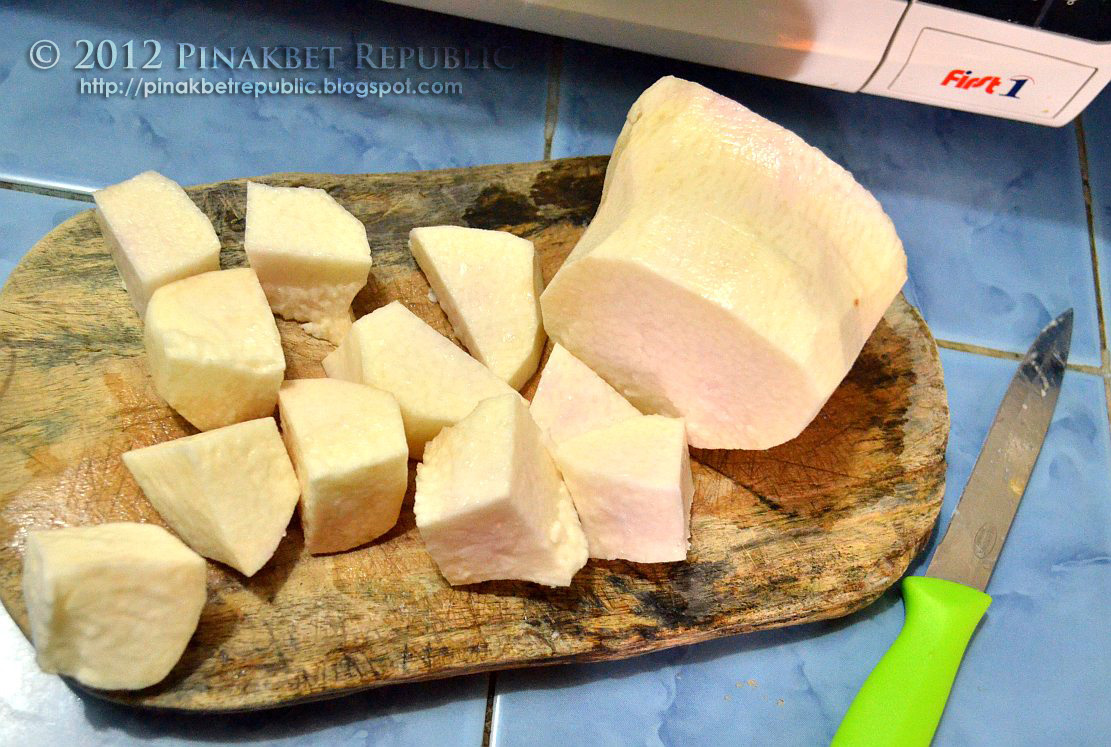
Preparing the ingredients to my buridibod. Peeling up, cutting up...


The yam simmering with fried tilapia heads atop to savor and bless it (I put in the quartered yam when the bugguong-flavored broth bubbled, with some sliced onions on the side):


Simmer until the yam is kind of tender, and then put in the veggies, tarong and pallang and okra first and then the kalunay atop. I topped it with another fried tilapia head just for the heck of it:

Cooking of the veggies should be quick, I don't want them wilted and soggy, I want them crisp as ever:


It's simple as that, the buridibod is done. I made it somewhat pulpy, taking advantage of its perfect starch, I mashed some cuts to make the broth thick and therefore rich and creamy. The fried tilapia has done justice for the dinengdeng to be more savory and tasty. Mangantayon! 


(Can't ge enough of puraw nga ube buridibud? Try my kamote buridibod or my tugi buridibod. And wait for my "ube nga ube"--purple yam--buridibod!)


:::::

11/22/2012

a hearty ilokano lunch by the seaside in ilocos sur

I've just came from a meeting of minds with some Ilokano writers, but what I can't help thinking about, or should I say craving about is the sumptuous lunch served during the meet up. Of course this is Ilocos Sur, right by the heart of the Ilokano country in the town of San Juan (a.k.a. Lapog) and right by a seaside barangay called Saoang.

This is my labay, pardon my gluttony:


And this is Saoang beach, the tide is low that time and so the breeze is kind of exotic, as it is strongly flavored with the scent of salt and reef: 


Dinengdeng nga utong ken pallang with rabok (gabi root):


A salad of radish fruit and KBL (tomato, bugguong, young onions):


An igado version of San Juan folks:


Pinakbet with lots of patani:


Fried malaga:


Steamed ipon:


What we feasted on:


Still burping...
:::::

10/01/2012

lomi iti banga in laoag

Thick and hot lomi in Laoag city.

I love lomi when it's thick, tasty, savory, spicy, creamy... thickened, especially, thick, even when it's getting cold. Of course, lomi is also popular amongst noodle-hungry Ilokanos because we're all Pinoys here obsessed with pancit although we somehow detest real pasta the Italian way (that's why we have sweet spaghetti, for instance, courtesy of the popular fastfood chains, hmmm. Lomi, and/or other noodle dishes like canton, bijon, is as sikat as, say, Ilocos miki or hi-bol.

I found this lomihan (lomi house) one rainy afternoon, its a small hole in the wall-type eatery wedged along rows of carinderias near the corner of Gov. Primo Lazaro and Gov. Julio Agcaoili Streets in Laoag City, just across the new GMW Bus terminal. The lomihan has no visible name or I might failed to see it because I only mind my extreme hunger, of the cold as I was soaked by the rain. I was curious because of groups of people, mostly college students I presume, gathered infront waiting for their turn at the few but fully occupied tables inside the steamy lomi house. And yes, the invitable aroma of something palatable wafting from the boiling lomi being served in cute claypots (banga). This is lomi iti banga. And it's only served in a banga, unusually not in bowls, so much so that when I placed an order, being alone, I was forced to try to consume a serving of lomi good for 3 to 5 persons, which is kind of cheap because it's only PhP60 or so, way cheaper than the lomis at Savory's and/or Leng-Leng's in Tuguegarao City.


Well, my lomi is served steaming hot and yes, extremely thick with the apparent egg-fused soup. It's topped with fried garlic which I guess is native Ilocos garlic because of its distinct aroma.


The noodle is just as good as a lomi pasta should be, sweet and creamy and delicious. The whole lot of the thick soup/broth is so comfortingly good because of the kikiam  (que-kiam) which added more flavor, and those hints of other bits of I guess is ground pork meat.


Besides adding the obligatory calamansi squeeze to sour it a bit, I spiced my lomi with some chili to take more advantage of its heat-generating capabilities to induce more sweat in me, as the cold rain pours more intense, mercilessly outside.


I might have eaten just 3 bowlfuls out of the banga and I'm full, filled to the brim. Sorry, but I can't finish it all off to the bottom of the claypot, it's a torture, I'm suffused with sweat and my tummy is so heavy and all I want is to settle in my reserved bus seat and sleep all night on the way home to Cagayan.


Verdict? Read it all again and relive my lomi adventure in Laoag. I highly recommend it to all lomi lovers.


:::::