dinengdeng, glorious dinengdeng!

I'm a typical Ilokano who can't live without dinengdeng, come share my passion...

various authentic, exotic, ilokano pinakbets

Concoction or variations of this kind of exotic Ilokano dish, of this ever ubiquitous vegetable stew...

sinanglaw? paksiw? which?

What do you prefer, Vigan-sinanglaw or Laoag-paksiw? What about pinapaitan and singkutsar?

unnok/ginukan, freshwater shellfish

Want some unnok soup or ginukan bugguong?

baradibud a tugi, lesser yam vegetable stew

Tugi, for some, is only meant to be boiled and eaten simply as is. But for me, it's an indispensable ingredient for yet another hearty Ilokano dish...

Showing posts with label Food Recipes. Show all posts

9/21/2021

kilawen a bilis, raw herring/sardine

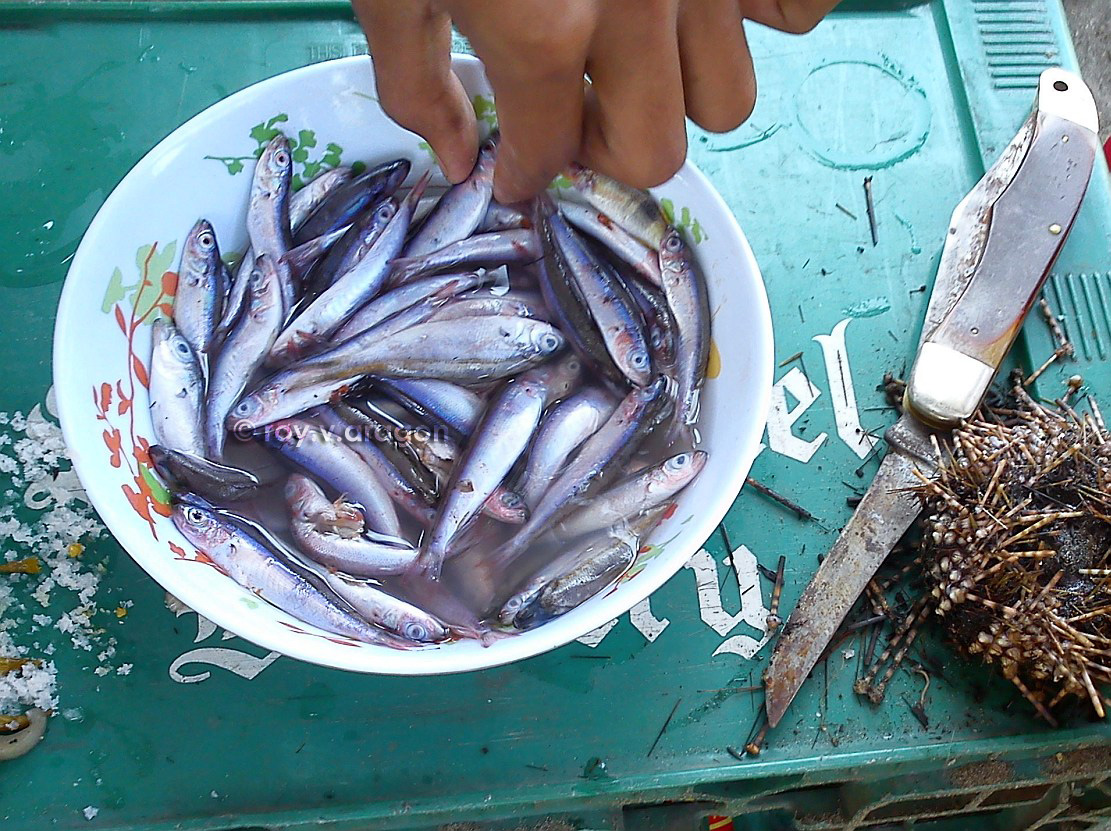
 Bilis is the local sardine/herring fish (family clupeidae) which is usually consumed raw or cooked in vinegar. I like it raw or kilawen (kinilaw). Fresh bilis is prized for its sweetish flesh and oily texture (which is common in sardine and herring fishes). I came upon a fresh bilis catch from Aparri (Cagayan) town and immediately prepared some for kinilaw.

486kilawenlames1


Here's my video of the process:


I removed head and guts and washed the fish well. You can opt to fillet the fish (remove the fishbone) for a more presentable kinilaw. But for me, this time, I'm over-eager to consume it so I didn't remove the siit anymore--I'll just take care of it when I'll eat them one by one, hehehe! After washing the decapitated and gutted fish, tossed it in vinegar, minced onions and crushed and minced garlic and ginger, some salt (add cracked pepper if you like), and chilis fermented in vinegar. It's that simple. The vinegar will simply "cook" the bilis. Put in a freezer for some minutes if you want, for all the ingredients/spices to blend well with the fish flesh.

486kilawenlames2

A close up of this heavenly delicacy. See the oily skin? Great texture. The flesh is so sweetishly sour and so delicious and sumptuous with its distinct sardiny smell that blesses the palate with the taste and aroma of the raw sea:

Perfect for pulutan and as an appetizer. Mangantayon! (Originally blogged December 2, 2009) 


Some comments from the original post:
 Marlene Says:
02 December 2009 at 2:05 pm e

Saan ko pay a naramanan to fresh fish. It looks like it’s safe. i would like to try some but where can i get it here in Vancouver, Canada

 Rey Says:
02 December 2009 at 4:47 pm e

Wow ang sarap, maalala ko while i was still in the Philippines, yan ang lagi naming ginagawa specially pag season sa isdang yan. i wish mayron din yan d2 sa Vancouver.

 Vicky Says:
03 December 2009 at 5:36 pm e

Tinagan na pay kanyami no dadakel ket Baranban, ibabad ti iloko suka, pamienta ken asin overnight kinabigatan ket iprito daytoy, talaga nga naimas daytoy.

In germany this kind of fish called Herring. They eat as kilawen too,With vinegar, lots of Onion, pepper and salt.When we eat ,take the tail and start the upper part of the fish ( w/out head and bone of course)

08 December 2009 at 8:11 am e

I don’t know if this is an original Ilocano dish. When I was in Italy, they were serving this kind of dish. Meron nga lang olive oil.

 Marlene Says:
08 December 2009 at 12:25 pm e

okey that is called herring here in vancouver. i see that fish pickled and looks tasty.

 rva Says:
08 December 2009 at 12:53 pm e

bilis is classified as a sardine fish and is under the family Clupeidae which also include herrings, shads, anchovies, etc. it might be a subspecies of the pacific herring (Clupea pallasii). another species is the atlantic herring.

anyway, herring is also traditionally eaten raw in the netherlands and in some other scandinavian countries.

see http://en.wikipedia.org/wiki/Herring and http://en.wikipedia.org/wiki/Clupeidae

 aurora lambino Says:
02 January 2010 at 2:28 pm e

Thank you for this blog. I truly enjoyed looking at all your post(s), specially the pictured ilokano dishes. My mother used to cook “all” these when we were growing up in Baguio (ie my mother is a migrant from Sto Domingo, Ilocos Sur). Have not mastered any of those featured.. I do a “quasi” job with frozen ingredients I find in the supermarket doing binug-goongan nga saluyot ken marunggay, when my 96 Year old mother craves for these.. Thanks again, I will try to find squash flowers in the summer. Definitely recommending it to my friends,


:::::


More kilawen nga ikan:

Follow also Ilokano Food @ Instagram and subscribe to Ilokano Food YoutTube channel for more photos, videos, and stories about Ilokano food, cooking, cuisine, and culture.


8/21/2021

kilawen a tirong: a picnic by the beach [repost]

Tirong is small saltwater fish. It's called bonnet mouth fish and is the ingredient in the popular bugguong (bagoong, fish sauce/paste) called bugguong a tirong. Tirong when fully grown (to its adult size) is called "dalagang bukid" and is great for sinigang and escabeche or simply as fried. And of course, the inevitable kilawen, freshly caught tirong eaten raw with the pristine saltiness and sweetness and succulence of the raw sea.


Kilawen a tirong.

Stopping by at Candon City on our way to a writer's convention in La Union, we decided to rest awhile and while away the thick and humid Ilocos summer heat and take a dip at the Ilocos Sur sea.


We went to a beach at Barangay Calungboyan and there we were lucky enough to come upon some fishermen who just came ashore in a rakit (balsa, bamboo raft) with their sea bounty.


There, the precious tirong, about 3 kilos of it, the only catch so far of the jolly Ilokano mangngalap (fisherman), besides a single pana-pana (sea urchin) and a baby kurita (octopus).


We bought all the tirong, of course, as we are so over-eager to have a taste of its freshness, its inviting deliciousness, its mouth-watering rawness...

We unanimously voted to have it as kilawen. No way should its freshness and succulence be wasted! And so we simply made it with available condiments. We poured vinegar on the tirong and it's done, it's that simple. With some salt and chili by the side.


You have to pick the tirong by hand, have some salt on it and eat it right on, have your mouth and palate some guilty pleasures. Its flesh is sweetish, a little bitter because of its intact entrails, briny with the natural taste of the raw sea. Eat it all, fishhead and fishbone, it's so small you can chew all its goodness.


And but of course, it's more palatable and with drinks, its inevitable partner. We've got a case of Red Horse Litro to down the great kilawen a tirong.


Ah! Goodness gracious, how refreshing and delectable life could be at the seashore. Life's a beach, indeed!


Drinkers. :-)

Calongbuyan Beach
Candon City, Ilocos Sur.


:::::


11/11/2013

pancit chronicles, episode 3: batil patung @ eva's panciteria, tuguegarao city

Pancit Batil Patung @ Eva's Panciteria (Annafunan Panciteria), Tuguegarao City.
Eva’s Panciteria (a.k.a. Annafunan Panciteria) is one of the most famous panciterias in Tuguegarao City, it being one of the most secluded that only the pancit batil patong “addicts” in the city can easily locate to satisfy their pancitly urge. Seclusion, or perhaps even secrecy (they don’t even have signages or billboards), made some panciterias in Tuguegarao the more popular as only the so-called real pancit connoisseurs bother to reach or are challenged to find these literal holes in the wall noodle houses. And I mean literal houses. Like the equally famous and secluded Lamud’s (or ECP, whatever) Panciteria in Barangay Cataggaman Nuevo, that panciteria in Barangay Annafunan is a noodle nook right in a residential house painted yellow (it was mentioned as a “green house” in Claude Tayag and Mary Ann Quioc’s Linamnam: Eating One’s Way Around the Philippines. Yes, Eva’s Panciteria (as Annafunan Panciteria) is listed in this culinary travel book, one of the only three batil patong panciterias mentioned, the two others being Lamud’s Panciteria and ECL Panciteria [in Barangay Carig]).
Batil patong time, past 3PM, with some pancit gourmands, at Eva's Panciteria.
And this is Manang Eva, the famous batil patong cook, dubbed and crowned as “Batil Patong Queen” in the city by her loyal pancit eaters and followers:


Just like most panciterias in the city, the kitchen and the cooking of the batil patong that you ordered is open for the curious (and envious) to gawk or observe upon. Here, you can watch the skills of a bating patong cook, and here, Manang Eva is really exceptional and impressive she could be a pancit chef in the White House alongside Chef Cristeta Comerford:


And so, after about 15 minutes of waiting, here are our orders, plates runneth over with heaps of carabeef meat, pork liver and egg toppings:


Pancit batil patong pure goodness topped with sautéed ground carabao meat and pork liver adobo and poached egg. No other fancy toppings of lechon carajay bits or pulverized pork cracklings, no veggies either, sorry, but it’s this simple and basic enough. A really gorgeous pancit, if you ask me:

The poached egg is just as perfectly rare or medium rare:

The egg oozing over the whole of the batil patong. And of course, the obligatory chopped raw sibuyas:

And with the accompanying egg soup. And yes, with the ubiquitous Tuguegarao-made “Malabon” brand soy sauce. In Tuguegarao, batil patong is not batil patong, if not flavored by this unique soy sauce. It maybe an acquired taste, but we so-called pancit aficionados in Tuguegarao swear and attest that other soy sauce brands won’t just fit in, they spoil the batil patongness of the real Tuguegarao batil patong, amen:

The egg reigning over. Extraordinary, this batil patong, is:

Spicing it a bit, with cracked paminta:

Enjoying the batil patong is naturally messy, it’s a required way to relish it, you can’t get away with all the sauces and juices, flavor and aroma fused to serve you all the goodness of a real batil patong. And here, Eva’s Panciteria’s version will not fail your strict expectation and craving for the original one, the all-meaty essence has only enhanced the pancitness of the whole pancit thing without any extra veggie flavor to intrude the taste and deliciousness. The miki or noodles is just cooked perfectly right, the sautéed meat to meet and please even the most finicky who can’t bear the intense and distinctive carabao meat smell (angdod, anggo):


And I can’t help but to finish off my plate, my cup of soup, and that saucer of onions with calamansi and sili. For sure, I’m one satisfied suki from hereon, Eva’s Panciteria will be among my list of must-be-there panciterias in the city, I’m one lucky bastard who finally found it, it’s a real quest, a literal one, what with the numerous wrong alleys and turns before finally finding the place, it’s a gastronomic el dorado of sort:


Be there, experience the quest, too, if you’re a pers taym adventurer, search it along the crooks and crannies of Annafunan East. It’s at the end of Aquino Street if you’re from the main road in Annafunan going to Barangay Linao, the street right across the Catholic church. Or take the interior road from Atulayan Norte going to Linao, passing Sunshine Valley Homes II, turn to a small street entering through some bamboo thickets along the main road. Sounds challenging enough, go!

UPDATE: As of this blog post, Eva’s Panciteria has moved to a separate sort of a building of its own, bigger and more spacious, located in the same compound in Annafunan East, just beside the old yellow-painted panciteria. I’ll be posting a part two soon about my new batil patong experience in the new Eva’s Panciteria. New place, but of course, the same phenomenal pancit batil patong that only Manang Eva can create:


More pancit batil patong stories:


:::::

10/22/2013

ginisa a rabong, sautéed bamboo shoot

Ginisa a rabong.
To continue my rabong cooking escapade,from the huge shoot that I prepared and boiled as base for lotsa more dishes, here’s one universal rabong favorite: ginisa a rabong, bamboo shoot sautéed in cooking oil with lots of garlic, onions, and (for me, lotsa) ginger. This is simple basic dish but like the rabong salad, it’s a certified appetizer with all the goodness of rabong’s flavor enhanced by its spices.

Note that ginisa a rabong is distinct (as far as I’m concerned, anyway) from that of adobo a rabong. The adobo version, although sautéed the same, has, of course, soy sauce, and vinegar. Ginisa a rabong is not laced with soy sauce but with salt only, or patis, or even bugguong. And my preferred ginisa a rabong has no vinegar because I don’t want it sour. If I want a soured rabong, I’ll make it instead into an achara (pickled bamboo shoot).

Here’s the precooked rabong being sautéed in cooking oil in lots of crushed garlic, sliced onions and crushed ginger. I add more ginger because I wanted the spicy zing of the ginger, I used native small ginger here because it’s spicier:

Add some salt or patis and keep on stirring the ginisa for the flavor and aroma to blend well with the rabong. I add some powdered pepper (cracked one is better, though) just before putting off fire. I also add a pinch of sugar just to resemble the sweetness of a ginettaan a rabong. Just a little sugar to sweeten it a bit (this is optional, others might not want a sweetish ginisa a rabong, but for me I want it sweet than being sour [vinegar added]):

And here’s it, my hot, spicy and sweet ginisa a rabong, bring in your newly steamed rice, and let’s partake this bamboo delight:


:::::

7/20/2013

"native" chicken adobo

One of my incessant food cravings, whenever I long for my being a "barriotic" or "promdi" is a lunch or supper where in the lowly dulang (literally a low wooden dining table) is set and served a bowl of piping hot soup called tinola or lauya a manok, or a manok adobo. And that the chicken must be, as it should be, a "native" one. Well, the so-called "kamanokan," the free-range almost-wild but domesticated one, of course, the usual poultry "dingo" in the barrios, in the away. As a child in Casantolan, we used to have scores of native chickens, and so, occasionally we have our meaty meals to augment our protein needs as we folks are usually more used to a vegetarian diet then, with the scarcity and expensiveness of meat or fish (or simply because we can't afford it).
Naadobo a netib a manok.

And so, on my recent visit to my place, it's SOP that I have to pamper myself a bit and afford a lauya or adobo, what with the fact that when I saw these creatures (photos below), pardon, I saw them dressed and boiling and steaming and wafting that familiar "native" aroma:


So, here's it, I caught my choice one from the brood and imprisoned the poor creature:


And he's here being slowly made into an adobo (sorry, sorry, poor creature, that I came and hungry I came; as a courtesy to its great sacrificial role, I won't show the butchering photos here anymore):


After about an hour or less of slow wood fire cooking, the meat is tender enough, the soup simmered and thickened into just a little broth that literally cooked the chicken in its own oily essence. This adobo version is simple, it's cooked with only the basic condiment and spices of garlic, onions, ginger, and salt. No vinegar and soy sauce. Some call it "white adobo." But I cooked it this way with a purpose: the rest of it (but of course, we Ilokano rural folks are that frugal, you know, we don't consume such a delicious treat at once but we set aside some pieces for the next meals) will be boiled again later as a lauya or tinola complete with green papayas and young sili leaves, and with more ginger for a zest:

And again with my dented tin plate, I made a labay of chicken and rice:


Care to see my labay, here are some of my choice chicken cuts (click photo to enlarge) -- the ulo (head), the karaykay (feet), bagis (intestines), the luppo (thights) and so on. Missing are the kimmol (tail), payak (wings), tengnged (neck), and the prized ones: the dalem (liver) and the batikuleng (gizzard). Those are rightfully set aside to grace the tinola later:

Ah, the nativity of it all, I shall return again to Casantolan, the real return of the native to his native soil and to his native gluttony of sort. :-)


:::::