dinengdeng, glorious dinengdeng!

I'm a typical Ilokano who can't live without dinengdeng, come share my passion...

various authentic, exotic, ilokano pinakbets

Concoction or variations of this kind of exotic Ilokano dish, of this ever ubiquitous vegetable stew...

sinanglaw? paksiw? which?

What do you prefer, Vigan-sinanglaw or Laoag-paksiw? What about pinapaitan and singkutsar?

unnok/ginukan, freshwater shellfish

Want some unnok soup or ginukan bugguong?

baradibud a tugi, lesser yam vegetable stew

Tugi, for some, is only meant to be boiled and eaten simply as is. But for me, it's an indispensable ingredient for yet another hearty Ilokano dish...

Showing posts with label Fish Sauce. Show all posts

3/09/2013

ubog ti way, rattan bud (heart)

Tinuno nga ubog ti way, narekaduan iti kamatis, bugguong ken lasona. (Click photo for a larger view) 
It's becoming rare that I see ubog ti way (rattan bud) in my market forays, especially so in Cagayan, so When I chanced upon some bundles of ubogs sold at the public market in Gonzaga, Cagayan, I bought outright a bundle of four large and smaller pieces for Php100:


Maybe even rattan vines in the remaining forested areas are rare these days what with the demand of rattan craft and furniture by some people fond of "native" decor. And of course, the denuding of forests due to illegal logging of the trees with which the rattans climbs and dwells, so what can we expect?


But anyway, the first thing in mind when I saw these childhood favorite (yes, I as a child has live in bitter life--that is, an Ilokano child of a poor family in a farming community, used to simple vegetable dishes like papait, paria and ubog [in our place, though rattan is also rare, there used to be a wild or smaller variety called barit on which the bid of it is equally bitter and sumptous]), is that I'll be grilling them over fire and make it into a delicious ubog salad--tinuno nga ubog ti way with KBL (kamatis, bugguong, lasona)--so, here I roasted them ubogs over gas fire, the only available fire I've got at the moment, it could have been better over wood or charcoal fire but it's not available, this will suffice, as long as it'd be roasted evenly and well:

And here's is, the cooked ubog inside the burnt bark:

I cut the cooked ubog thinly, with kamatis and lasona:

And here's the end-result of my labor of love--thinly sliced ubog ti way, garnished with tomatoes and onions and drenched with bugguong essence--I tell you, it's like heaven, an ambrosia of sort, the bittery goodness lingered in my palate as I savored memories and tastes and flavors and delights of childhood and the simplicity and modesty of rural life which I always miss, the bittery quality and pride of being an Ilokano:


The next day, I decided on a dinengdeng nga ubog with the remaining pieces--with patani and kalalaki nga alukon (see separate blog post on my dinengdeng a kalalaki nga aluko and ubog ti way):

I cleaned the raw ubog to get just the heart of it, the precious bud:


And again, I thinly sliced the ubog for my dinengdeng--see how promising it is, the sweetish bitterness it brings to satisfy any dinengdeng- and pait-freak Ilokano that there is:


And this is it, my dinengdeng--what a bliss, what a blessing to be able to partake such gastronomic opportunity like this, once more, again, in a lifetime:
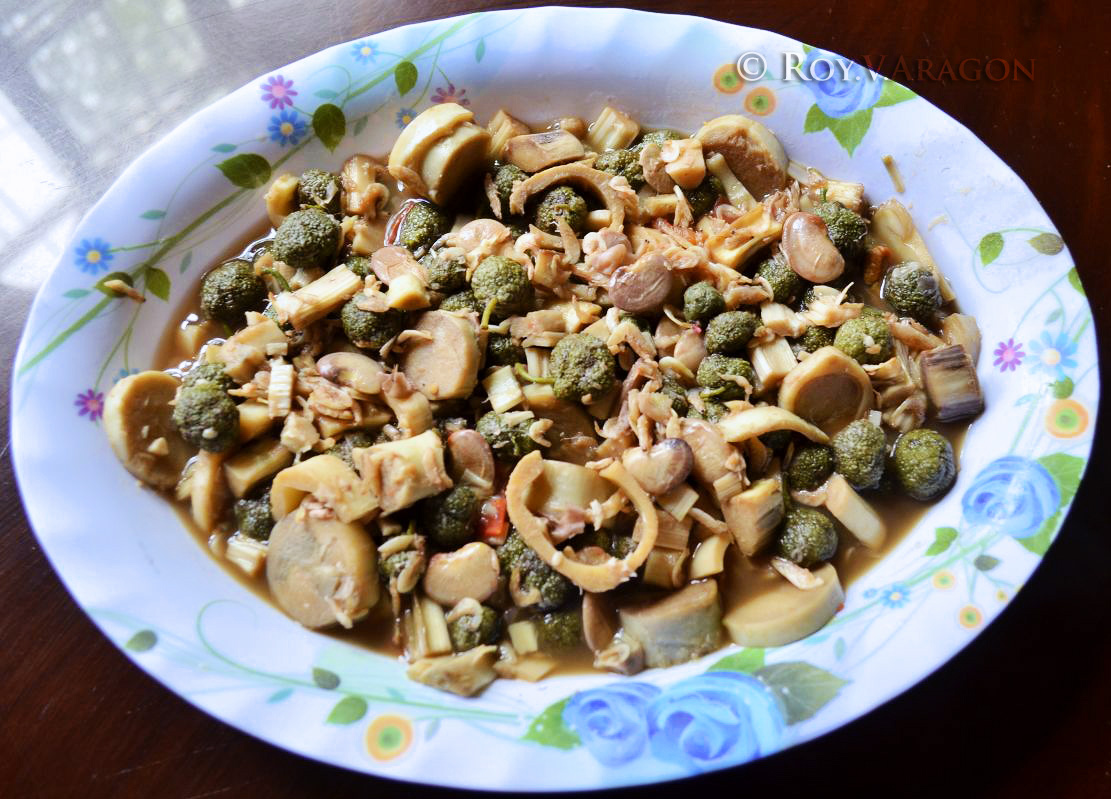


:::::

6/05/2012

saluyot & tarong

What to do with these? Saluyot and tarong. And this tarong, the "white" variety (actually green but called "puraw a tarong") which is somewhat rare and not usually available every market time, and which is good for some simple tarong dishes.
Saluyot ken tarong.
(click on photo for a larger view)
First with the tarong, I want it fried (prito a tarong) as this variety of eggplant is perfect for frying as it is rather huge and its flesh is soft, tender. I sliced it length-wise into thin strips, sprinkled some Pasuquin salt on the slices and deep fried it quickly in boiling cooking oil, when done I drained its oil and served it with bugguong squeezed with calamansi. Delicious for breakfast, or even for lunch or dinner. (Click on photos for a larger view.)


The next meal time, I made a dinengdeng a saluyot ken tarong with fried tilapia:


And lastly, when only some few saluyot stalks are left, I decided on a pinakbet or paksiw a saluyot (also caled "tinimtiman a saluyot") with dried fish as sagpaw (add-on):
Dried fish from Santa Ana, Cagayan.
I boiled a minimal amount of water with the bugguong. I put in the dried fish fist and let it boil. Simmered, then I put in some onions and Ilocos garlic (from Pinili, Ilocos Norte at that!), the the saluyot. When it's almost done, I added a few drops of vinegar (luckily I still have apple cider left), cooked it some more, and then it's ready. Cooked it almost dry, with just a little thick broth for a tasty labay. 


.....

5/25/2012

pinakbet ingredients


These, typically, are the vegetable ingredients of the famous pinakbet, the basic of which, are tarong (eggplant), paria (bitter melon), kamatis (tomato), okra and the obligatory lasona/sibuyas (onion), bawang (garlic) and laya (ginger). These the basic ingredients of an authentic Ilokano pinakbet. Or may be even reduced to only paria, tarong kamatis, in some cases where no other vegatables are readily available to be picked in the garden when the bugguong broth is already boiling. These are the basic essentials, Ilokano-wise, period. Sweet chili (sili nga aruy-oy) may be an staple but it's only an add on, just like utong or kardis. And please, please, no karabasa (squash fruit), because a real Ilokano pinakbet has no karabasa in it but only in a Tagalog pakbet (which is usually sautéed, bagoong-alamang-flavored, and with broth akin to a soup, etc.). And only "native" round paria is used, not the hybrid longish ones which is not that any bitter at all. Pait (bitterness) after all defines Ilokano palate.


Paria.

Tarong. The longish, slender ones are preferred for pinakbet. Also the small green (white) round ones.

Okra.

Kamatis, lasona, bawang.

With laya.


Some of the other optional ingredients:

Kardis (kadyos, pigeon pea)

Bagas ti kamote (kaong, camote, sweet potato). This is used in an Ilokano pinakbet, instead of karabasa, to sweeten and thicken the broth.


Sili nga aruy-oy.

Bunga ti marunggay.


Bunga ti utong.

Kabatiti.

Patani. 

Pallang (winged bean)

Alukon (Photo by Leilanie Adriano)

Bunga ti Singkamas (Photo from Ilokano Food)

And now, to the pinakbets!


.....


2/09/2012

saluyot and rabong variation--with bulong-sili, kalunay and utong

Now, talking more about dinengdeng, when rabong (bamboo shoots) is mentioned, among Ilokano folks, it is usually and readily thought so as being the righteous or de facto pair of the quintessential and ever-ubiquitous saluyot (Corchorus olitorius), that's it, dinengdeng a rabong ken saluyot: partners.


But then, as a veggie, rabong can go with almost any other veggies for that exclusively Ilokano-branded dinengdeng or inabraw.


Like, for instance, rabong with kalunay (Amaranthus spinosus) or kalkalunay (Spinacia oleracea) and the tender leaves of sili ti sairo/abuyo (bird's eye chili, Capsicum frutescens), and with bunga ti utong (string beans):


These freshly picked veggie goodies, with a little big help of bugguong...

Kalunay, local spinach.

Bulong/uggot ti sili, bird's eye chili.

Bunga ti utong, string beans.

... will turn into a delectable dinengdeng like this, with fried galunggong (round scad) to flavor:


Still, the open secret is that you have to cook it the veggies briskly and briefly, don't overcook, especially the leafy ones. Boil the shredded rabong first (some folks parboil rabong before cooking it as dinengdeng, to rid of its bitterness; but that depends on the variety of bamboo, some like the bayog (Bambusa spinosa) kind, sometimes doesn't need to be parboiled and rinsed; some Ilokano folks even prefer their rabong to be a bit bitter, anyway). When the rabong is tender, put in the utong, simmer for some minutes, and then put in the kalunay and sili leaves. Simmer for a minute then put off fire and remove the pot's cover so the leaves don't wilt. Serve immediately.