dinengdeng, glorious dinengdeng!

I'm a typical Ilokano who can't live without dinengdeng, come share my passion...

various authentic, exotic, ilokano pinakbets

Concoction or variations of this kind of exotic Ilokano dish, of this ever ubiquitous vegetable stew...

sinanglaw? paksiw? which?

What do you prefer, Vigan-sinanglaw or Laoag-paksiw? What about pinapaitan and singkutsar?

unnok/ginukan, freshwater shellfish

Want some unnok soup or ginukan bugguong?

baradibud a tugi, lesser yam vegetable stew

Tugi, for some, is only meant to be boiled and eaten simply as is. But for me, it's an indispensable ingredient for yet another hearty Ilokano dish...

Showing posts with label Roots. Show all posts

7/13/2020

yet another buridibod, with marunggay pods, shucked clam meat and grilled malaga (repost)

I'm so in love with buridibud (buribod, baradibud; vegetables and root crop stew) that I always cook/consume this authentic Ilokano dish--as often as when I came upon any available ingredients in my regular forays in the veggie/wet local markets. Especially when it's alukon season, I always make a buridibod with alukon flowerettes and other greens like marunggay leaves and pechay (especially the small murumor ones, pechay sowed and grown like seedlings; or petchay with flowers).

And it's also perfect with young/immature marunggay pod or fruit (more popularly known as "drumstick" elsewhere outside the Philippines, especially in India).

I was a bit lucky that market day because aside from the abundance of marunggay pods and camotes, I also chanced upon heaps of shucked and dried small freshwater clam meat; and in the fish section, a bountiful supply of one of the fish I love--malaga (rabbitfish; rare and pricey in this parts).

The dried clam meat is from the tukmem (or bennek, or dukkiang). It's called "narnar" in Cagayan (also called "gasagas" or "ginasagas" owing to the process of how it was shucked from its shell, using a bigao-like bamboo strainer similar to "karadikad"). It's usually added to dinengdeng, or made into a delicious ukoy (fritter or patty).

"Narnar"

A close-up look at the "narnar"


Malaga fish to be grilled

These would be great for my buridibod! The malaga will be grilled a put atop a narnar-suffused buridibud!

Camote and marunggay pod (fruit)

This is how I "muri" or prepare the marunggay pods.

The grilled malaga

As with my other versions of buridibod, I boil bugguong first, and then put in the camote, and the marunggay pods after the camote is slightly cooked. (You can lightly mash some of the tender camote cubes if you want a more pulpy and sweeter broth.) The pods should not be overcooked. Next, I put in the the "narnar," and a few minutes before serving I put atop the grilled malaga. (You can put the fish earlier as in other sagpaw, but malaga is very delicate in that its flesh will become "maburbor" (disintegrated) if it's cooked for quite a longer time.)

And here's it, steaming right from the pot, ready to be served hot.


Here's the final product:


A closer look to savor its sumptous beauty:

4/14/2015

dinengdeng/baradibud a kamangeg, samsamping, parda ken kabatiti; wild yam with blue pea, hyacinth bean and sponge gourd

Samsamping, parda ken kabatiti a nabaradibudan iti bagas ti kamangeg.
Yet another rare chance, opportunity, if you will, to find something like these wild bounty of the land right in a local market in the city--yessir, that's the rare wild yam kamangeg (Dioscorea luzonensis), a one of a kind edible tuber that grows wild just in the wild "deeply embedded in hardened soil in forested and mountainous areas" in the Ilocos; and to top it, there's another wild vegetable that yet again just grows wildly: samsamping (Clitoria ternatea Linn; in some areas it is called kalumpagi; blue pea in English).

I always see a yet another delicious starchy dinengdeng called buridibud when I see kamangeg, So this is yet another opportunity to make one, what with the perfect willd veggie fruit of a samsamping to pair it.


Luckily, I also got another so-called "native" Ilokano vegetable fruit: parda (Dolichos lablab Linn; hyacinth bean) which is just so good a pair for my buridibud.


So, there, this parda:

And the samsamping:


I also got the smaller and sweter native kabatiti (sponge gourd; not photographed) as another veggie fruit for that perfect buridibud. Together they will grace my platefuls of steamed rice. But first things first, I boiled some bugguong in a minimal amount of water, with some slices of onions for aroma and flavor. Afterwhich I simmered into the bubbling bugguong mixture the cut kamangeg, let it cook for about 20-30 minutes and then into it the kabatiti, samsamping and parda. Here it is, stewing and becoming thick and starchy:


And here's it, done! The broth is just as rich and thick and so flavorful and deliciously starchy and sweet. The fruit veggies are just cooked right not overcooked, to retain it's gorgeous color and crispness:


A really simple and easy dish but so good and healthy. Just plain dinengdeng/buridibud without sagpaws or add-ons to really savor the veggies and the rare kamangeg. Absolutely amazing Ilokano food!


:::::


12/31/2012

dinengdeng/buridibod nga ube, purple yam stew with veggies

Ube or ubi, the "real" and popularly known ube (purple yam; being different from that of "puraw nga ube"). I was lucky enough to spot huge pieces of ube roots being sold by industrious folks displaying garden produce and wild leafy greens and roots along the national highway in Iguig, Cagayan (exactly on the Tuguegarao-Iguig boundary arch, on that road going to the Saint Clare Monastery, where vendors usually sell vegetables, wild mushrooms, freshwater fish and shells, edible insects, etc. to the devotees who flock the monastery chapel every Sunday and on holidays). I readily bought a 2-kilogram worth at PhP30 a kilo.

And so with it, I continue my buridibod/baradibod-making escapade (after kamote, tugi, and puraw nga ube):


This is quite large, more that two kilograms actually, but this is medium sized compared to the other roots for sale. I only need this for now, for my ube buridibod of the day (actually this is good for even five buridibud serving/cooking):


Freshly picked vegetables are also on sale so I have pallang, sabong ti karabasa and bilonak (kubay, alugbati) for the buridibod:


The bilonak is so fresh, I set asided half of the bundle for a salad later:


Peeling up the ube and cutting it up into cubes--see how purple, how lavender, how violet it is?


The veggies... and it's ready!


My ube buridibod cooking. As is the "tradition" in dinengdeng-making, I put in the ube when the bugguong broth bubbled, for it to cook first and when it's tender, the veggies to be cooked briefly to retain its "greenery" and crispness--the pallang is somewhat sweet when it's not overcooked:


And here's it again, in its fullness and basicness (no sagpaw this time, just plain ube and veggies). Again, I made the ube gave in its starchy richness to thicken and sweeten the broth and the whole of the dinengdeng/buridibod:

It's so good, I almost ate the dinengdeng solo (alunos), with almost no rice! How about that?


:::::


12/30/2012

dinengdeng/buridibod nga ube (puraw), white yam stew with veggies and fried fish

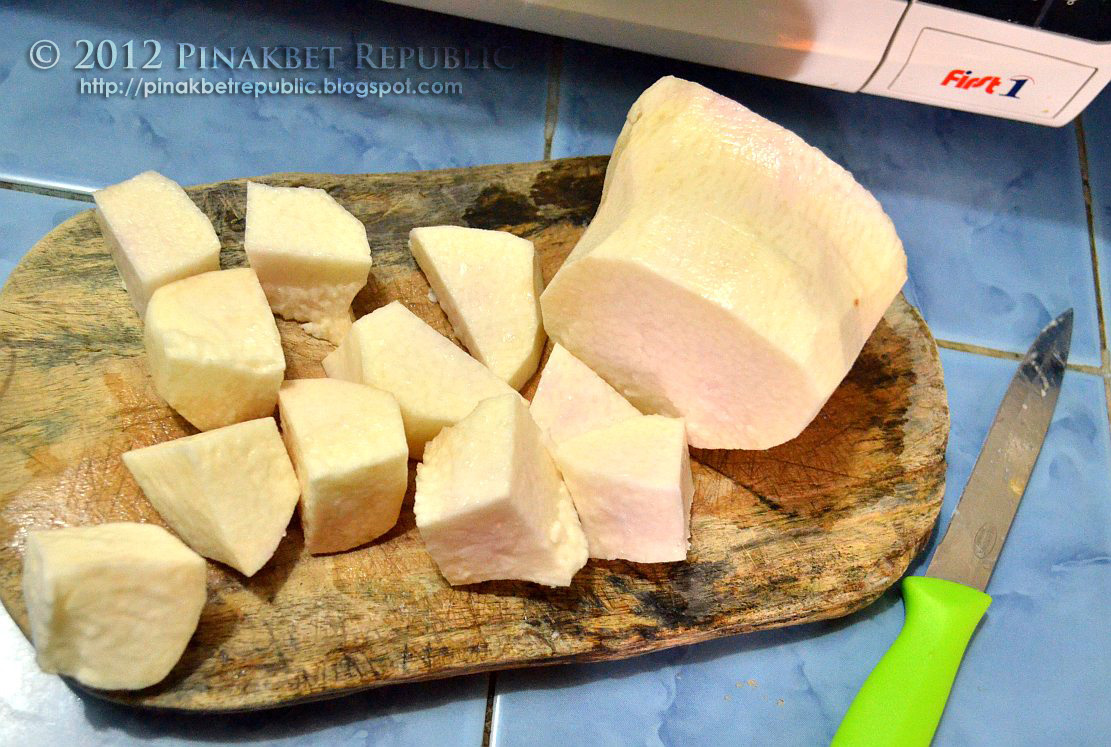
Buridibod/baradibud, still. That unique Ilokano vegetable dish suffused with tubers or roots, specifically yams and that of sweet potato (camote, kamotig, kamotit, or kaong). We've done it with tugi (lesser yam). Now, let's do it with yet another yam, a white yam commonly called "puraw nga ube" in Allacapan, Cagayan (puraw because it's not lavender or violet as in purple yam, which is the popularly known ube [ube itself is the color purple/violet]). Whatever it is (I suspect it's buga, but I'm not keen with these wild Philippine yams), it's one perfect yam for buridibod:


The digging. This yam rooted itself deep down afoot a citrus tree in Brgy Tamboli, Allacapan, Cagayan:


See, it promises a really humongous root, with that slender vine into it, akin to a floating tiny tip of a giant iceberg:


And there it is, the hulk and bulk of a root, our white yam finally dug out for all to see (the smaller one is a separate part):


I contented myself with the smaller root, it will suffice a couple of good buridibods. I paired it with kalunay (native spinach, amaranth, kulitis), pallang, tarong and okra:


Preparing the ingredients to my buridibod. Peeling up, cutting up...


The yam simmering with fried tilapia heads atop to savor and bless it (I put in the quartered yam when the bugguong-flavored broth bubbled, with some sliced onions on the side):


Simmer until the yam is kind of tender, and then put in the veggies, tarong and pallang and okra first and then the kalunay atop. I topped it with another fried tilapia head just for the heck of it:

Cooking of the veggies should be quick, I don't want them wilted and soggy, I want them crisp as ever:


It's simple as that, the buridibod is done. I made it somewhat pulpy, taking advantage of its perfect starch, I mashed some cuts to make the broth thick and therefore rich and creamy. The fried tilapia has done justice for the dinengdeng to be more savory and tasty. Mangantayon! 


(Can't ge enough of puraw nga ube buridibud? Try my kamote buridibod or my tugi buridibod. And wait for my "ube nga ube"--purple yam--buridibod!)


:::::

6/15/2012

daludal, sagibsib, taro shoots/suckers

Paksiw (inalseman) a daludal.

Aba (gabi, taro), besides its preferred leaves and stems, and its inevitable bagas (corm), is also an important vegetable specially among Ilokanos because of its daludal (or sagibsib, also sammimit), the shoot or sucker which grows from the corm. It can be consumed as regular veggie and can be in the company of other leafy greens and veggie fruits for a delicious and hearty dinengdeng, prized for its slimy texture akin to a saluyot. It can be cooked in coconut milk just like laing. Or as a solo dinengdeng with broth. Or as a paksiw or pakbet (soured), cooked dry.

Daludal for sale in a roadside talipapa.

Daludal being cleaned and readied for the next dinengdeng or paksiw.

Cleaned daludal ready for cooking.

Paksiw a daludal done. Cook it just like a dinengdeng, only, use a small amount of water boiled for the bugguong. Add-in crushed garlic, ginger, onions. And sour it with some drops of vinegar (don't put in too much vinegar). Or green mangoes, if available. Or pias (kamias). Or young tamarind fruit. That's it. Cook it well to prevent "itchiness" (just like the way you cook taro's leaves, stems, corm).


.....