dinengdeng, glorious dinengdeng!

I'm a typical Ilokano who can't live without dinengdeng, come share my passion...

various authentic, exotic, ilokano pinakbets

Concoction or variations of this kind of exotic Ilokano dish, of this ever ubiquitous vegetable stew...

sinanglaw? paksiw? which?

What do you prefer, Vigan-sinanglaw or Laoag-paksiw? What about pinapaitan and singkutsar?

unnok/ginukan, freshwater shellfish

Want some unnok soup or ginukan bugguong?

baradibud a tugi, lesser yam vegetable stew

Tugi, for some, is only meant to be boiled and eaten simply as is. But for me, it's an indispensable ingredient for yet another hearty Ilokano dish...

5/21/2012

kilawen a tirong, a picnic by the beach

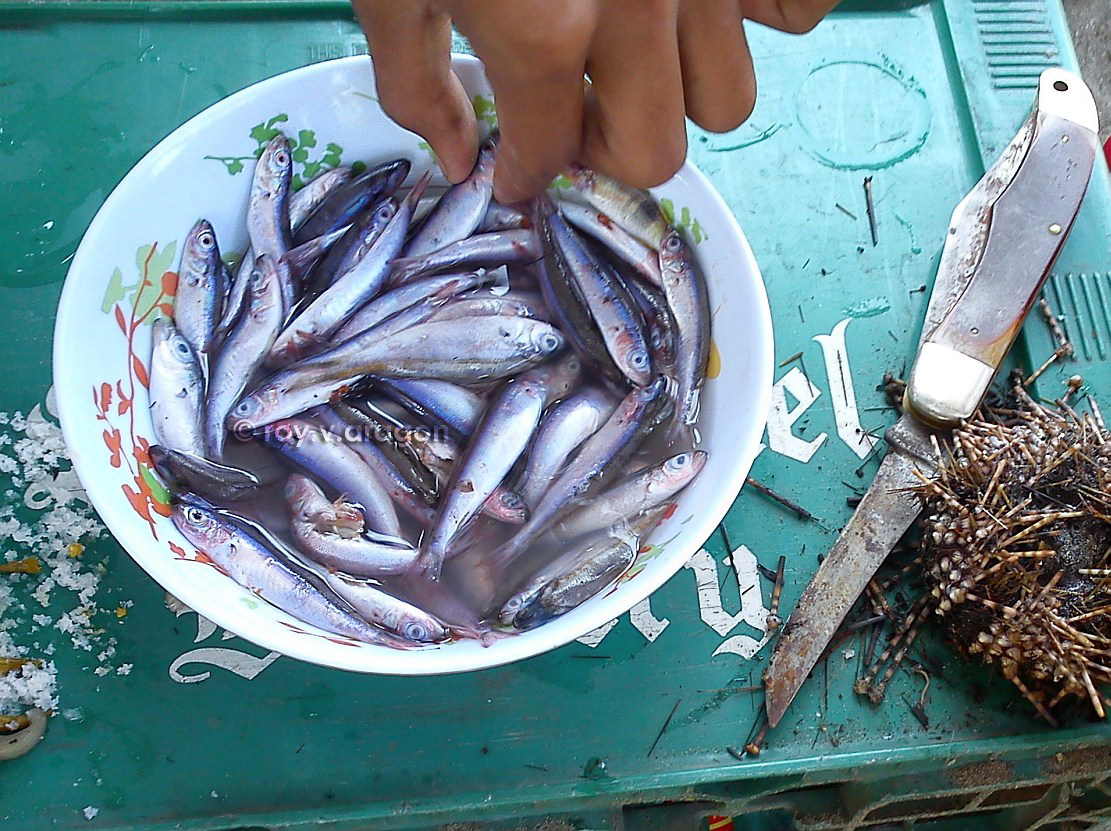
Tirong is small saltwater fish. It's called bonnet mouth fish and is the ingredient in the popular bugguong (bagoong, fish sauce/paste) called bugguong a tirong. Tirong when fully grown (to its adult size) is called "dalagang bukid" and is great for sinigang and escabeche or simply as fried. And of course, the inevitable kilawen, freshly caught tirong eaten raw with the pristine saltiness and sweetness and succulence of the raw sea.


Kilawen a tirong.

Stopping by at Candon City on our way to a writer's convention in La Union, we decided to rest awhile and while away the thick and humid Ilocos summer heat and take a dip at the Ilocos Sur sea.


We went to a beach at Barangay Calungboyan and there we were lucky enough to come upon some fishermen who just came ashore in a rakit (balsa, bamboo raft) with their sea bounty.


There, the precious tirong, about 3 kilos of it, the only catch so far of the jolly Ilokano mangngalap (fisherman), besides a single pana-pana (sea urchin) and a baby kurita (octopus).


We bought all the tirong, of course, as we are so over-eager to have a taste of its freshness, its inviting deliciousness, its mouth-watering rawness...

We unanimously voted to have it as kilawen. No way should its freshness and succulence be wasted! And so we simply made it with available condiments. We poured vinegar on the tirong and it's done, it's that simple. With some salt and chili by the side.


You have to pick the tirong by hand, have some salt on it and eat it right on, have your mouth and palate some guilty pleasures. Its flesh is sweetish, a little bitter because of its intact entrails, briny with the natural taste of the raw sea. Eat it all, fishhead and fishbone, it's so small you can chew all its goodness.


And but of course, it's more palatable and with drinks, its inevitable partner. We've got a case of Red Horse Litro to down the great kilawen a tirong.


Ah! Goodness gracious, how refreshing and delectable life could be at the seashore. Life's a beach, indeed!


Drinkers. :-)

Calongbuyan Beach
Candon City, Ilocos Sur.


:::::


5/19/2012

octopus adobo

Kurita. Octopus. At its freshest state of being, freshly caught and brought out from the sea, kurita is priceless for its sweet succulence. I chanced upon a kurita in the local wet market one Sunday morning. I decided to make it into an adobo a kurita, one of the most common dish made with octopuses and squids.


Wash the kurita thoroughly. Cut it in bite size. Discard the innards, spare some of the ink sac to be used to thicken and "blacken" the adobo.

I cooked it just like like what an adobo should be. But because this is not the usual pork or chicken or beef meat, I had to saute the garlic (browned) and onions (caramelized) first in cooking oil, And then I briefly stir fried the cut kurita, poured in some ink, some soy sauce, some vinegar and some cracked peppers. Cooking kurita should be quick, get it done with a few stirs. Do not overcooked or the kurita becomes like a hard rubber/plastic. Cook it as fast as possible to retain its soft texture and sweetish freshness.

I made mine thicker with more ink. You can moderate thickness or blackness by the amount of ink you put in. I think I made it with more ink as this looks like a dinardaraan (dinuguan, blood stew) than an adobo! Ha-ha!


......

5/09/2012

dinengdeng once more, because one can live in dinengdeng alone

And here we come again, and what else but to indulge yet again on dinengdengs, I can't help it, really! This is sweet indulgence, and if this is some kind of an addiction, I'm a willing victim, I oblige, me, a bugguong lover.

And here are more of the recent beloved dinengdengs that I lovingly made and faithfully enjoyed:

Pallang, tarong, marunggay, with grilled fish.
(Click on photo for a larger view)

This really is a medley! You have there a unique black utong (string beans), patani (lima/broad beans), kardis (kadios, pigeon pea), and kalunay (local spinach or amaranth). 
(Click on photo for a larger view)

Utong, patani, kardis, marunggay leaves, with grilled bangus.
(Click on photo for a larger view)

Utong, okra, singkamas (jicama) fruit, with grilled fish. Photo from Pasuquin, Ilocos Norte FB Page.
(Click on photo for a larger view)

Utong, kabatiti, with clams. Photo by Leilanie Adriano
(Click on photo for a larger view)

Alukon flowerettes, with dried fish.
(Click on photo for a larger view)

Aba (gabi, taro) stalks, leaves and root stewed with lots of crushed ginger to make it spicier. I added a little cane vinegar to sour it. If available, use fresh young tamarind fruit, or green mango, or pias (kamias).
(Click on photo for a larger view)


.....

5/06/2012

kilawen a pusit/laki, squid ceviche

Laki. Or pusit. Squid. Preferably fresh, it's prepared, cooked, and served in a variety of ways. As a soup with souring agents like tomatoes or pias, stewed, as an adobo, grilled, stuffed, as a kilawen, etc. It's an all-year round sea bounty readily available in your local/public wet market.

We came upon this unusually huge laki being sold in a roadside talipapa
along the Maharlika Highway in Tuguegarao City and we preferred
to buy it singly than some smaller ones. This one weighs one and a half kilos!
(Click photo for a larger view)

To take advantage of its pristine freshness, we decided to make
it into a kilawen (ceviche).  The laki was cut, its head and
entrails (its ink sac preserved) removed and set aside;
its plastic-like "bone" or gladius discarded. 
(Click photo for a larger view)

The laki flesh was scalded with boiling water and then simmered with it for some minutes to slightly cook. It should not be overcooked else the flesh will toughen. It should stay soft and succulent.
(Click photo for a larger view)

Cutting the laki flesh into flat, bite-size strips done. Onions and ginger, next.
(Click photo for a larger view)

Then the calamansi...
(Click photo for a larger view)

The calamansi is squeezed into, its seeds strained...
(Click photo for a larger view)

... And here's the kilawen a laki or pusit. Thoroughly mixed with the onions, ginger, calamansi juice, and seasoned with some salt (pepper is optional, but chili fermented in vinegar is better). The flesh is so palatable and delicious, succulent and sweet, softly chewy.
(Click photo for a larger view)


Perfect as pulotan (finger food) for drinks.
(Click photo for a larger view)

Meanwhile, the head, tentacles and entrails were cut, with the ink,
 and prepared for a sinigang a pusitWith some tomatoes, onions, ginger, garlic.
(Click photo for a larger view)

Saute sliced onions, cracked garlic, some tomatoes. Then add in the sliced laki. Stir fry quickly. Add the squid ink. Stir to evenly mix. Then add some water. Optionally if you it more spicy, add some hot peppers (chili). Boil  and simmer quickly. Season with salt. Put off fire and serve immediately. Do not overcook, or the laki will become tough.
(Click photo for a larger view)
The squid sinigang's savory black soup.
(Click photo for a larger view)


.....

4/18/2012

kilawen a bilis redux, sardine/herring ceviche

Bilis ceviche.

Bilis, the local sardine (or is it really herring?). It's always abundant and whenever it's freshly available, I always buy a kilo or a half for kilawen (as a ceviche). This fish is prized as a kilawen in most parts of the globe, anyway. Perfect as an appetizer, and great for pulutan (to go with drinks).

Freshly caught bilis for sale in Santa Ana, Cagayan.


Bilis.


Kilawen a bilis ready for a sumptous consumption. 
[See previous blog post on how to prepare bilis  kilawen]


Bilis ceviche with its buddies.


:::::


4/17/2012

more pinakbet... from ilokanos around the web

Pinakbet once more, because we can't just get enough of pinakbet, we always want for more, and more. So here are some from Ilokanos around and on the web. These are various pinakbets but authentic Ilokano pinakbet because these were prepared by Ilokano (except the last photo, which can be conveniently labeled as "pakbet-tagalog" because it has karabasa and bugguong-aramang is used instead of bugguong a lames).

Enjoy!

Pinakbet with shrimps, from Hawaii, courtesy of Jonathan Torricer.
(click on photo for a larger view)

Photo by Twinnie Jap Herasio.
(click on photo for a larger view)

Pinakbet in San Nicolas, Ilocos Norte. Photo by Derick Yabes.
(click on photo for a larger view)

Pinakbet in Pasuquin, Ilocos Norte.
(click on photo for a larger view)

Pinakbet with tinuno a palileng. Photo by Mary Jane Tordil.
(click on photo for a larger view)

Photo by Maureen Veenstra.
(click on photo for a larger view)

Photo by Noel Viernes.
(click on photo for a larger view)


Pakbet-Tagalog, photo by Noel Viernes. 
(click on photo for a larger view)


.....

4/13/2012

bunog/birut/bukto/palileng, mullet/goby fish

Here's more on bunog (in general, called talimusak in Tagalog, variably called birut, bukto, even palileng, or mori, and udingan, ipusan, etc.; it's actually mullet or goby fish.), smallish freshwater/river fish best stewed in lots of tomatoes, onions, garlic, ginger and some vinegar. Or wrapped in banana leaves and steamed/cooked as a tamales. Or dipped in spiced flour and deep fried to a crunchy treat.


....